
Mock Test 1
00:00
What does this sign mean?
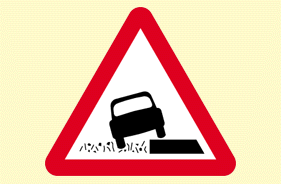
00:00
How can you help to ease traffic congestion?
00:00
You're following a motorcyclist along a potholed road. How should you adjust your driving to take account of this situation?
00:00
You're driving a slow-moving vehicle on a narrow, winding road. What should you do to let other vehicles overtake you?
00:00
What does this sign mean?
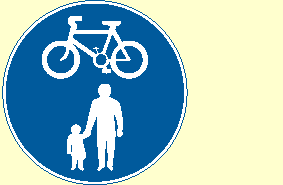
00:00
You're scheduled to make a delivery. You arrive at your destination during the morning rush hour. The road is edged with double red lines. What do they mean?
00:00
You're driving in a built-up area. Your vehicle is fitted with an audible warning device that sounds when it's reversing. When must you turn off this alarm?
00:00
Under EU rules, what's the maximum daily driving time allowed?
00:00
The height of your vehicle is 4.2 metres (14 feet). What should you do as you approach this bridge?
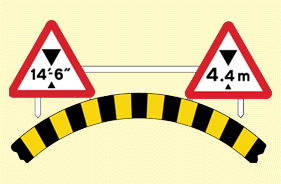
00:00
What's the best knot to use when securing a load with ropes?
00:00
What's the minimum distance you should allow for braking when it's raining heavily?
00:00
This vehicle is fitted with spray-suppression equipment. In what weather conditions will it be most useful?
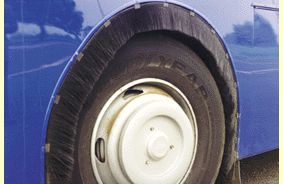
00:00
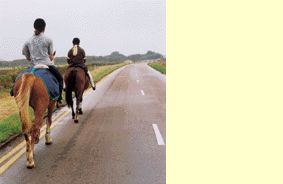
You're about to overtake horse riders. What could scare the horses?
00:00
How should you stand when you're lifting a heavy object?
00:00
How does alcohol affect your driving?
00:00
You've stopped at a pelican crossing. What should you do if the lights have changed to green but a disabled person is still crossing?
00:00
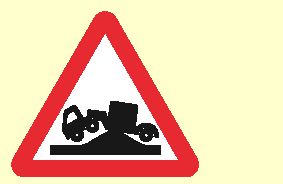
What does this sign mean?
00:00
What helps you to become a fuel-efficient driver?
00:00
In what circumstances will short-wheelbase vehicles bounce more noticeably than long-wheelbase vehicles?
00:00
Why are energy-saving tyres effective?
00:00
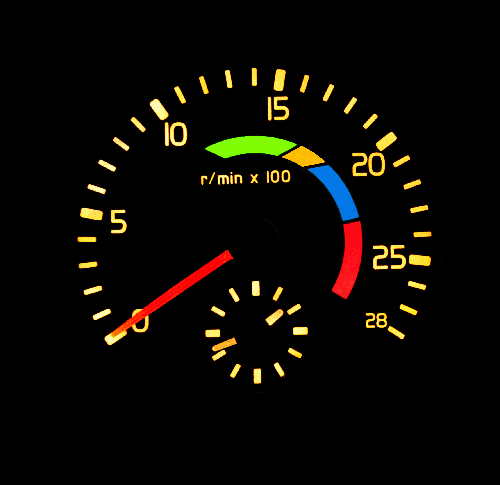
Which coloured band on the rev counter makes the best use of engine braking?
00:00
Which symbol on a lorry means it's likely to be carrying compressed gases?
00:00
What should you do to prevent fuel spillage?
00:00
You're driving a tractor unit fitted with two air lines. You want to couple to a trailer that has three air-line couplings. How should the air lines be connected?
00:00
How will a school crossing patrol signal you to stop?
00:00
You arrive at the scene of an incident where someone is injured. What should be given urgent priority?
00:00
When may vehicles over 7.5 tonnes maximum authorised mass (MAM) use the right-hand lane of a motorway to overtake?
00:00
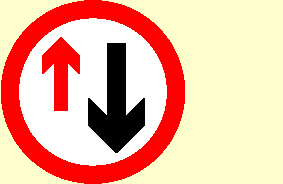
Who has priority when you're approaching this sign?
00:00
Your lorry is stuck in snow. You use the diff-lock to move off. When should you switch the diff-lock off?
00:00
What's the fifth-wheel coupling used for?
00:00
The analogue tachograph on your vehicle becomes faulty. How long do you have before you must have it repaired?
00:00
What should you do when you're unable to see clearly while you're reversing into a loading bay?
00:00
What's the greatest risk to your safety when you're overtaking on a motorway in very wet weather?
00:00
A group of horse riders comes towards you. What should you do if the leading rider's horse becomes nervous of your presence?
00:00
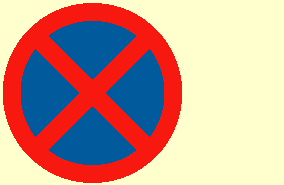
What does this sign mean?
00:00
Why are motorcyclists more at risk from other road users?
00:00
Why is a toucan crossing different from other crossings?
00:00
What can cause unnecessary pollution to the environment?
00:00
You're on a wet, level road, driving at 50 mph. What's the minimum time gap you should leave between your vehicle and the one in front?
00:00
You've been asked to drive a fully loaded petrol tanker back to the depot. It has a maximum authorised mass of 10 tonnes. What must you have before you can drive this vehicle?
00:00
When are exhaust brakes most efficient?
00:00
You're waiting at a T-junction. What should you do if you see a vehicle is coming from the right, with its left indicator flashing?
00:00
What will happen if you drive smoothly?
00:00
You're driving on a road with an uneven surface. What should you do if you're following a motorcyclist along this road?
00:00
When is a buffer lane most likely to be in use?
Not enough to pass :-(
You have answered 0 correct out of 45 question(s).
Question: {counter}
{question}
- {options}