
Practice Test 23
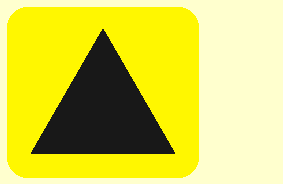
What does this sign mean?
You've been involved in an incident and damaged some property. What should you do if nobody else is present and your vehicle is still roadworthy?
Poor eating habits can increase your risk of long-term health problems. What may result from a poor diet?
You're turning right onto a dual carriageway from a side road. What should you do if your vehicle is too long for the gap in the central reservation?
You're driving on a single carriageway. When may you use your mobile phone?
What should you do when you want to join a motorway where traffic is flowing freely?
Usually, a rev counter is divided into coloured bands. Which band should you stay in for maximum fuel economy?
When are you most likely to lose concentration while you're driving?
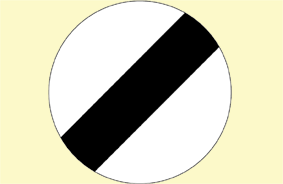
You're driving a lorry weighing more than 7.5 tonnes on a dual carriageway in England. What does this sign mean?
When should you consider the effect a speed limiter will have on your vehicle?
You're about to drive home. What should you do if you feel very tired and have a severe headache?
How many copies of the CMR consignment note are required?
You're driving in fog that's starting to clear. When should you switch off your high-intensity rear fog lights?
You're loading timber onto a flat-bed lorry. You want to cover it with sheets. Which sheet should be positioned first?
When should you use the two-second rule?
You arrive at the scene of an incident. A casualty has an injured arm that's bleeding heavily. What could you do to help while waiting for the emergency services to arrive?
What must you do before you leave your vehicle?
You’re about to overtake a cyclist on a road that has a 30 mph speed limit. How much room should you leave them as you overtake?
What should you do after overtaking on a dual carriageway?
You're driving an articulated lorry on a three-lane motorway. When can you drive in the right-hand lane?
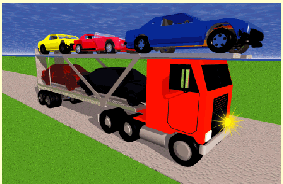
What should you do when you're following a motorcyclist on an uneven road?
You're waiting for the emergency services to arrive at the scene of an incident. A pedestrian's leg is bleeding heavily, but there's nothing embedded in the wound. What could you do to help?

You're entering a roundabout. What should you do if a cyclist in front of you is signalling to turn right?
During your break, your vehicle will be moved by another person. What should you do with the tachograph chart?
Your steering suddenly becomes heavy to turn. What could make this happen?
What must you do to ensure good all-round vision when driving?
You're trying to resuscitate a casualty who isn't breathing. For how long should you continue compressions if they haven't started breathing again?
Which road users are most likely to be affected by the turbulence created by large vehicles travelling at speed?
What's the national speed limit on a motorway for a lorry weighing over 7.5 tonnes?
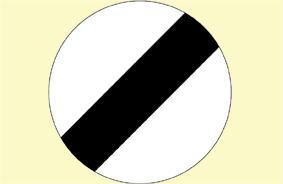
You're driving a lorry with a maximum authorised mass of 38 tonnes on a single carriageway road in England. What's the speed limit for your vehicle after passing this sign?
What can prevent you from holding a bus or lorry driving licence?
Your lorry has a double-deck body. The top tier is loaded and the lower deck is empty. When will the vehicle be most at risk of overturning?
You're turning right from a main road into a side road. There's no oncoming traffic. What should you do if pedestrians are standing on the pavement waiting to cross the side road?
What's the fifth-wheel coupling used for?
You're driving in wet weather. What effect will faulty spray-suppression equipment have on other drivers?
You're driving a lorry carrying a load that's 4.5 metres (14 feet 9 inches) wide. What's the maximum speed you're allowed to drive on a motorway?
Which of these loads needs to be transported at a controlled temperature?
Your vehicle is fitted with air-assisted hydraulic brakes. What fault would you suspect if the brake pedal becomes hard to press?
What would be affected by a vehicle with faulty suspension?
Who's responsible for making sure that cargo arrives undamaged?
What system is used to control a vehicle's speed without using the footbrake?
Your vehicle has broken down at night on a two-way road. How should you try to leave the vehicle?
Not enough to pass :-(
You have answered 0 correct out of 44 question(s).
What's Next?
Review your answers
See which answers you chose and what the correct answers are.
Study Guide
Review all the correct answers.