
Driving Theory Test | Driving Theory Test | Start Practicing For Free Today
All Tests
Progress 0%
1 2 3 4 5 6 7 8 9 10 11 12 13 14 15 16

0 Correct 0 Incorrect
Total Questions 16
Passing Marks 75%

Overall Progress


0%

View Stats
Challenge Bank

Vehicle handling

When may you wait in a box junction?

www.drivingtheorytest.uk - Vehicle handling - When may you wait in a box junction? The purpose of a box junction is to keep the junction clear by preventing vehicles from stopping in the path of crossing traffic.
You mustn't enter a box junction unless your exit is clear. However, you may enter the box and wait if you want to turn right and are only prevented from doing so by oncoming traffic.

When may you overtake another vehicle on their left?

The road is wet. Why would a motorcyclist steer around drain covers while they were cornering?

What’s the purpose of the yellow lines painted across the road?

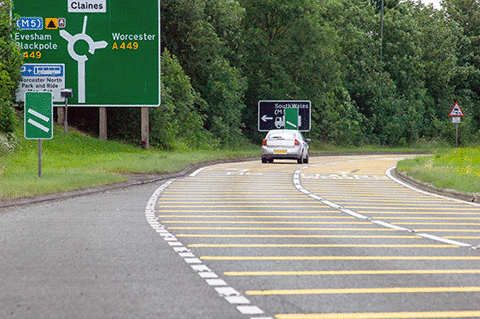
www.drivingtheorytest.uk - Vehicle handling - What’s the purpose of the yellow lines painted across the road? These lines may be painted on the road on the approach to a roundabout, a village or a particular hazard. The lines are raised and painted yellow, and their purpose is to make you aware of your speed. Reduce your speed in good time so that you avoid having to brake harshly over the last few metres before reaching the junction.

You're travelling in very heavy rain. How is this likely to affect your overall stopping distance?

What should you do if you have to make a journey in foggy conditions?

What should you do when you meet an oncoming vehicle on a single-track road?

Why should you reduce your speed when you're driving or riding in fog?

Which plate may appear with this road sign?

www.drivingtheorytest.uk - Vehicle handling - Which plate may appear with this road sign? Road humps are used to slow down traffic. They're found in places where there are often pedestrians, such as
• shopping areas
• near schools
• residential areas.
Watch out for people close to the kerb or crossing the road.

What's a rumble device designed to do?

www.drivingtheorytest.uk - Vehicle handling - What's a rumble device designed to do? A rumble device consists of raised markings or strips, designed to give drivers an audible, visual and tactile warning. These devices are used in various locations, including in the line separating the hard shoulder and the left-hand lane on the motorway and on the approach to some hazards, to alert drivers to the need to slow down.
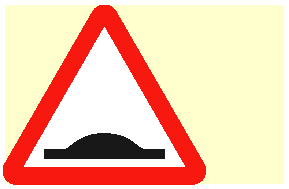
You're travelling on a road that has road humps. What should you do when the driver in front is travelling more slowly than you?

www.drivingtheorytest.uk - Vehicle handling - You're travelling on a road that has road humps. What should you do when the driver in front is travelling more slowly than you? Be patient and stay behind the car in front. You shouldn't normally overtake other vehicles in areas subject to traffic calming. If you overtake here, you may easily exceed the speed limit, defeating the purpose of the traffic-calming measures.
Why should you test your brakes after this hazard?

www.drivingtheorytest.uk - Vehicle handling - Why should you test your brakes after this hazard? A ford is a crossing over a stream that’s shallow enough to drive or ride through. After you’ve gone through a ford or deep puddle, your brakes will be wet and they won't work as well as usual. To dry them out, apply a light brake pressure while moving slowly. Don’t travel at normal speeds until you're sure your brakes are working properly again.

What colour are the reflective studs along the left-hand edge of the motorway?

What's the reason for traffic-calming measures?

What must you do when you're overtaking a car at night?

What should you do when you're overtaking at night?

Not enough to pass :-(

0%

You have answered 0 correct out of 16 question(s).


What's Next?

Review your answers


See which answers you chose and what the correct answers are.

Challenge Bank


Go through all your mistakes in all the tests you've taken so far.

Wrong answers

Study Guide


Review all the correct answers.


Question: {counter}

{question}

    {options}